OpenAI Releases Research Preview of 'gpt-oss-safeguard': Two…
OpenAI Releases Research Preview of ‘gpt-oss-safeguard’: Two Open-Weight Safety Reasoning Models for AI Moderation
SEO Meta Description
OpenAI introduces gpt-oss-safeguard, two open-weight safety reasoning models designed to help developers enforce custom safety policies at inference time. Learn about its features, use cases, and deployment strategies.
Introduction
OpenAI has unveiled a groundbreaking research preview of gpt-oss-safeguard, a pair of open-weight safety reasoning models designed to enhance AI moderation and content filtering. These models—gpt-oss-safeguard-120b and gpt-oss-safeguard-20b—allow developers to apply custom safety policies dynamically, making them highly adaptable for various applications, particularly in financial, business, and compliance-driven environments.
This article explores the key features, benefits, use cases, setup process, and cost considerations of gpt-oss-safeguard, along with a comparison to alternative solutions.
Overview of gpt-oss-safeguard
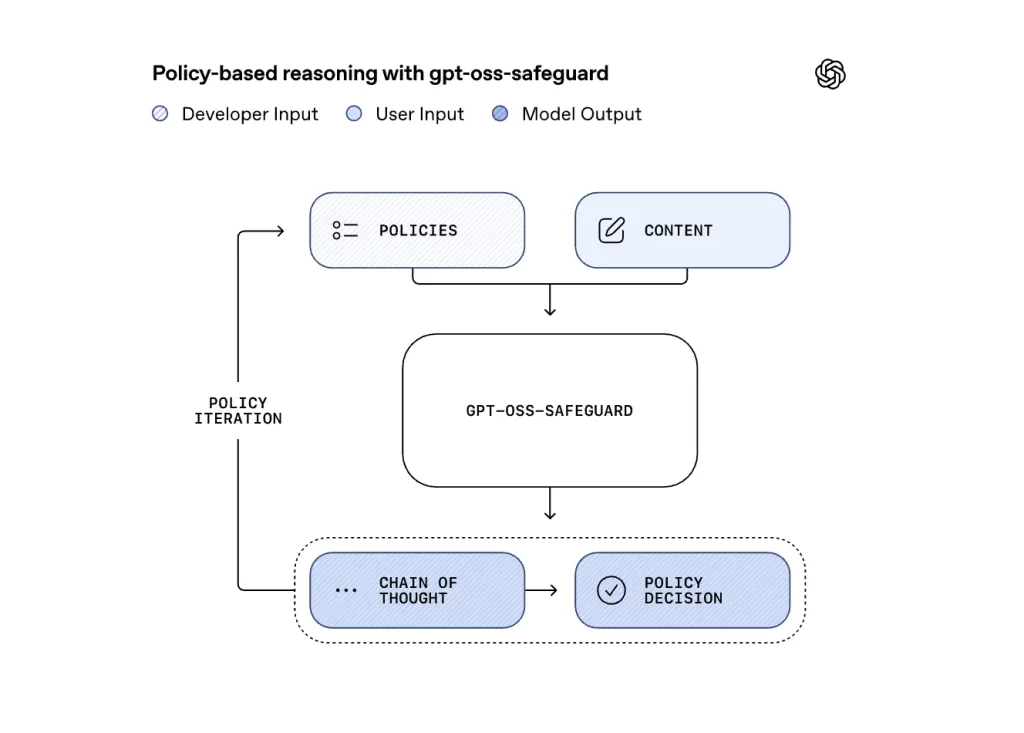
gpt-oss-safeguard is a novel approach to AI safety moderation, shifting from fixed-policy models to policy-conditioned reasoning. Unlike traditional moderation models, which require retraining when policies change, gpt-oss-safeguard evaluates content in real-time based on developer-defined policies. This flexibility makes it ideal for industries with evolving compliance requirements, such as finance, healthcare, and gaming.
The two models available are:
- gpt-oss-safeguard-120b (117B parameters, 5.1B active parameters)
- gpt-oss-safeguard-20b (21B parameters, 3.6B active parameters)
Both models are fine-tuned from gpt-oss and licensed under Apache 2.0, allowing commercial use and local deployment.
Key Features and Benefits
1. Policy-Conditioned Safety Reasoning
Unlike traditional moderation models, gpt-oss-safeguard evaluates content against custom policies provided by developers. This means:
- No need for retraining when policies change.
- Adaptability to domain-specific risks (e.g., fraud detection, self-harm prevention, or game-specific abuse).
2. High Accuracy in Multi-Policy Scenarios
OpenAI’s internal evaluations show that gpt-oss-safeguard outperforms gpt-5-thinking and gpt-oss baselines in multi-policy accuracy. While it closely matches OpenAI’s internal Safety Reasoner, the performance gap is not statistically significant, making it a strong open-source alternative.
3. Optimized for Real-World Deployment
- gpt-oss-safeguard-120b fits on a single 80GB H100-class GPU.
- gpt-oss-safeguard-20b is optimized for 16GB GPUs, making it suitable for smaller-scale deployments.
4. Asynchronous and Layered Moderation
OpenAI recommends a defense-in-depth approach:
- Use fast, high-recall classifiers for initial filtering.
- Route uncertain or sensitive content to gpt-oss-safeguard for deeper analysis.
- Optionally, run reasoning asynchronously for non-critical responses.
Use Cases in Finance and Business
1. Fraud Detection in Financial Services
Banks and fintech companies can use gpt-oss-safeguard to:
- Detect suspicious transactions in real-time.
- Adapt policies based on evolving fraud patterns without retraining models.
2. Compliance and Regulatory Adherence
Businesses in regulated industries (e.g., healthcare, legal) can enforce custom compliance policies while ensuring content aligns with industry standards.
3. Content Moderation for Social Platforms
Social media and gaming platforms can implement dynamic moderation rules to filter harmful content while minimizing false positives.
4. Automated Customer Support
AI-driven customer service bots can use gpt-oss-safeguard to ensure responses comply with brand guidelines and legal requirements.
Setup Process and Cost
1. Installation and Deployment
- Both models are available on Hugging Face under the Apache 2.0 license.
- Developers can deploy them locally using standard AI frameworks like PyTorch or TensorFlow.
2. Hardware Requirements
- gpt-oss-safeguard-120b: Requires an 80GB GPU (e.g., NVIDIA H100).
- gpt-oss-safeguard-20b: Works on 16GB GPUs (e.g., NVIDIA A100).
3. Cost Considerations
- No direct cost for the models themselves (open-source).
- GPU costs vary based on cloud provider (e.g., AWS, Google Cloud, Azure).
- Inference costs depend on usage volume and hardware selection.
Comparison with Alternatives
| Feature | gpt-oss-safeguard | OpenAI’s Internal Safety Reasoner | gpt-5-thinking | Traditional Moderation Models |
|---|---|---|---|---|
| Policy Flexibility | ✅ Dynamic, custom policies | ✅ Dynamic, custom policies | ❌ Fixed policies | ❌ Fixed policies |
| Performance | ✅ Competitive with OpenAI’s internal model | ✅ Best performance | ❌ Lower accuracy | ❌ Lower accuracy |
| Deployment Cost | ✅ Open-source, GPU-dependent | ❌ Proprietary, cloud-based | ❌ Proprietary, cloud-based | ❌ Proprietary, cloud-based |
| Use Case Adaptability | ✅ High (finance, gaming, compliance) | ✅ High | ❌ Limited | ❌ Limited |
Conclusion
gpt-oss-safeguard represents a significant leap in AI moderation, offering policy-conditioned reasoning that adapts to evolving business needs. Its open-weight architecture, competitive performance, and flexible deployment options make it a strong choice for enterprises seeking customizable, high-accuracy moderation solutions.
For businesses in finance, compliance, and content moderation, this tool provides a cost-effective, scalable, and future-proof way to enforce safety policies without the limitations of fixed-models.
Next Steps
- Explore the models on Hugging Face.
- Experiment with custom policy implementations.
- Integrate into existing moderation pipelines for real-world testing.
By leveraging gpt-oss-safeguard, organizations can enhance AI-driven decision-making while maintaining strict compliance and safety standards.