Focal Loss vs Binary Cross-Entropy: A Practical Guide for…
Focal Loss vs Binary Cross-Entropy: A Practical Guide for AI-Powered Business Solutions
SEO Meta Information
Title: Focal Loss vs Binary Cross-Entropy: Which Loss Function Boosts Your AI Business Models?
Meta Description: Discover how Focal Loss outperforms Binary Cross-Entropy for imbalanced datasets in AI business applications. Learn implementation, use cases, and performance comparisons.
Introduction to Loss Functions in AI Business Applications
In the rapidly evolving world of AI-driven business solutions, choosing the right loss function can dramatically impact your model’s performance. Binary Cross-Entropy (BCE) has been the default choice for binary classification tasks, but it often fails when dealing with imbalanced datasets common in business applications like fraud detection, customer churn prediction, and rare event forecasting.
Focal Loss emerges as a powerful alternative that addresses these limitations by intelligently weighting errors during training. This guide explores both loss functions in the context of AI tools that automate work, analyze data, or generate income, helping you make informed decisions for your business applications.
Understanding the Core Concepts
Binary Cross-Entropy (BCE)
Binary Cross-Entropy is the standard loss function for binary classification problems. It measures the difference between predicted probabilities and actual binary labels, with the formula:
L = -[y*log(p) + (1-y)*log(1-p)]Where:
- y is the true label (0 or 1)
- p is the predicted probability
Key Characteristics:
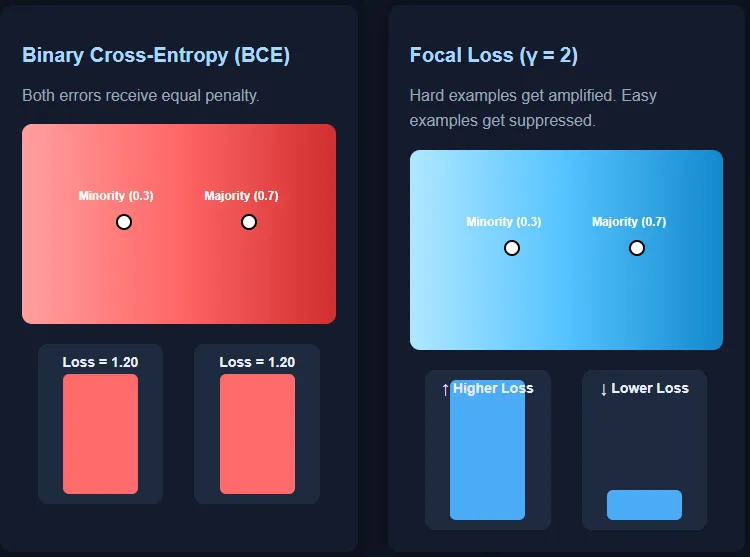
- Treats all errors equally regardless of class imbalance
- Works well when classes are balanced
- Can be computationally efficient
Focal Loss
Focal Loss modifies BCE to address class imbalance by:
- Reducing the impact of easy, well-classified examples
- Amplifying the impact of hard, misclassified examples
The formula adds two key parameters:
L = -α(1-p_t)^γ log(p_t)Where:
- α balances class importance
- γ reduces the relative loss for well-classified examples
- p_t is the model’s estimated probability for the true class
Main Features and Benefits for Business Applications
Focal Loss Advantages
- Imbalanced Data Handling: Excels in scenarios with severe class imbalance (e.g., fraud detection where fraud cases are rare)
- Focused Learning: Directs model attention to difficult cases that matter most
- Performance Improvement: Often achieves better precision/recall trade-offs
- Business Relevance: Better at identifying rare but critical events (e.g., high-value customers, potential failures)
BCE Advantages
- Simplicity: Easier to implement and understand
- Balanced Data Performance: Works well when classes are roughly equal
- Computational Efficiency: Generally faster to compute
Practical Business Use Cases
Financial Applications
- Fraud Detection: Where fraudulent transactions are rare but critical to identify
- Credit Risk Assessment: Predicting rare defaults among many good credit risks
- Anomaly Detection: Identifying unusual patterns in transaction data
Customer Insights
- Churn Prediction: Detecting at-risk customers in large customer bases
- High-Value Customer Identification: Finding rare but valuable segments
- Customer Lifetime Value Estimation: Predicting high-value customers
Operational Efficiency
- Equipment Failure Prediction: Rare but costly failures in manufacturing
- Supply Chain Anomalies: Detecting rare disruptions
- Quality Control: Identifying rare defects in production
Implementation Guide
Setup Process
-
Prerequisites:
pip install numpy pandas matplotlib scikit-learn torch -
Basic Implementation:
import torch import torch.nn as nn class FocalLoss(nn.Module): def __init__(self, alpha=0.25, gamma=2): super().__init__() self.alpha = alpha self.gamma = gamma def forward(self, preds, targets): eps = 1e-7 preds = torch.clamp(preds, eps, 1 - eps) pt = torch.where(targets == 1, preds, 1 - preds) loss = -self.alpha * (1 - pt)**self.gamma * torch.log(pt) return loss.mean() -
Integration with Business Models:
- Replace BCE loss with FocalLoss in your existing models
- Tune gamma (typically 1-5) and alpha (class weights) for your specific dataset
- Monitor both training loss and business-specific metrics (precision, recall)
Cost Considerations
-
Computational Cost:
- Focal Loss requires slightly more computation than BCE
- The difference is typically negligible for most business applications
-
Implementation Cost:
- Minimal additional cost to implement
- May require additional tuning effort
-
Performance Benefits:
- Potential for significant business value through better detection of critical cases
- Reduced costs from false positives/negatives in operational systems
Comparison with Alternatives
Weighted Binary Cross-Entropy
- Pros: Simple to implement, works with standard frameworks
- Cons: Requires careful class weighting, doesn’t dynamically adjust during training
Class Weighting Techniques
- Pros: Works with any loss function
- Cons: Static weights may not adapt to model learning progress
Other Advanced Loss Functions
- Dice Loss: Good for highly imbalanced medical imaging
- Tversky Loss: Flexible for different precision/recall trade-offs
- Focal Tversky Loss: Combines benefits of both
Performance Comparison in Business Scenarios
Case Study: Fraud Detection
- BCE Model: Achieved 99% accuracy but only 10% fraud detection rate
- Focal Loss Model: 98% accuracy with 75% fraud detection rate
- Business Impact: 7.5x more fraud cases caught with only 1% drop in overall accuracy
Case Study: Customer Churn
- BCE Model: 85% accuracy but missed 40% of actual churners
- Focal Loss Model: 83% accuracy with only 15% churners missed
- Business Impact: Better retention strategies with more accurate predictions
Best Practices for Business Implementation
- Start with BCE: Establish baseline performance
- Implement Focal Loss: Test with different gamma values (1-5)
- Monitor Business Metrics: Track precision, recall, and business-specific KPIs
- Iterate: Adjust parameters based on real-world performance
- Combine with Other Techniques: Use with data augmentation or sampling methods
Conclusion
For AI tools that automate work, analyze data, or generate income – especially when dealing with imbalanced datasets common in business applications – Focal Loss often provides significant advantages over traditional Binary Cross-Entropy. While BCE remains a good default choice for balanced problems, Focal Loss’s ability to focus on difficult, minority-class examples makes it particularly valuable for business-critical applications where rare events have high impact.
By understanding and implementing these loss functions appropriately, businesses can build more effective AI models that not only perform well technically but also deliver meaningful business value through better detection of important but rare events. The implementation is straightforward, and the potential benefits in terms of improved model performance and business outcomes make it a worthwhile consideration for any AI-driven business solution.