Ethereum Foundation veteran Dankrad Feist joins Stripe’s Tempo team
Ethereum Foundation Veteran Dankrad Feist Joins Stripe’s Tempo Team
Introduction
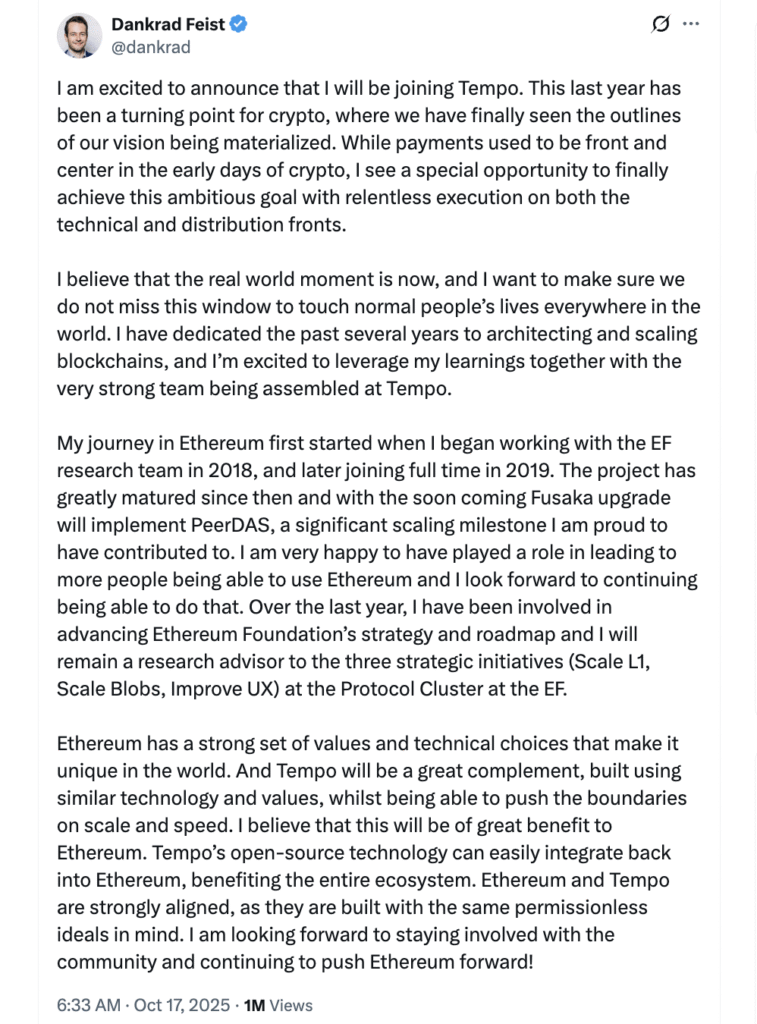
Dankrad Feist, a prominent Ethereum developer and researcher at the Ethereum Foundation, has announced his move to Stripe’s Tempo, a layer-1 blockchain focused on payments and stablecoins. While Feist will continue as a research adviser to Ethereum, his transition has sparked discussions within the crypto community about the future of blockchain interoperability and competition.
Key Details of the Transition
Feist will take on a new role at Tempo, a blockchain initiative backed by Stripe and Paradigm, while retaining his advisory position at the Ethereum Foundation. His responsibilities will include contributing to Ethereum’s scaling solutions, user experience improvements, and the development of “blobs”—a feature that enhances Ethereum’s data storage efficiency.
In a statement, Feist emphasized the alignment between Ethereum and Tempo, stating:
“Tempo’s open-source technology can easily integrate back into Ethereum, benefiting the entire ecosystem. Ethereum and Tempo are strongly aligned, as they are built with the same permissionless ideals in mind.”
Despite his departure, Feist reaffirmed his commitment to Ethereum’s growth, saying:
“I am looking forward to staying involved with the community and continuing to push Ethereum forward.”
Community Reactions: Support and Concerns
The announcement has elicited mixed reactions from the Ethereum community. While some supporters welcomed Feist’s new venture, others expressed concerns over the loss of a key contributor during a period of significant changes within the Ethereum ecosystem.
Critics have also questioned the necessity of Tempo as a standalone blockchain, with some arguing that Ethereum’s layer-2 solutions could suffice. Joe Petrich, head of engineering at NFT platform Courtyard, tweeted:
“No one wants another chain. There is no need for yet another chain.”
Ethereum Foundation researcher Devansh Mehta further criticized the approach, suggesting that Tempo could face centralization risks and legal challenges by operating as an independent layer-1 blockchain rather than a layer-2 solution.
Potential Impact on AI, Crypto, and Business
Feist’s move highlights the growing intersection of blockchain, payments, and decentralized finance (DeFi). Tempo’s focus on stablecoins and payments could influence how businesses adopt blockchain technology, particularly in cross-border transactions and financial services.
For Ethereum, the departure of a key researcher raises questions about talent retention amid increasing competition from alternative blockchains. However, Feist’s continued advisory role suggests that collaboration between Ethereum and Tempo may strengthen both ecosystems.
The debate also reflects broader tensions within the crypto space, where layer-2 solutions are both praised for scaling Ethereum and criticized for potentially diluting its revenue and ETH’s value.
Conclusion
Dankrad Feist’s transition to Stripe’s Tempo marks a significant shift in the blockchain landscape, blending Ethereum’s principles with a new payments-focused infrastructure. While the move has sparked debate, it underscores the evolving dynamics of decentralized finance and the ongoing quest for scalable, efficient blockchain solutions.
SEO Metadata
Title: Ethereum Veteran Dankrad Feist Joins Stripe’s Tempo: What It Means for Crypto
Meta Description: Dankrad Feist, a key Ethereum researcher, moves to Stripe’s Tempo blockchain. Explore the implications for Ethereum, stablecoins, and the future of decentralized finance.
This article maintains a neutral, journalistic tone while providing a comprehensive overview of the event, its key stakeholders, and its broader implications for the crypto and AI sectors.